
Dear Neighbor,
Strong, reliable infrastructure is essential to the well-being and safety of our community. Whether you’re walking around the neighborhood, driving to the grocery store, or bracing for a storm, you deserve streets, water pipes, and structures that keep you, your loved ones, and the place you call home protected. In this newsletter, you’ll find ways I’ve been working to support local infrastructure and tips to help you stay safe on the road and during severe weather events.
As always, my team and I are here to serve you. If you ever need help navigating resources or have questions, feedback, or concerns you’d like to share, please don’t hesitate to contact my office.
Sincerely,

Stephanie Chang
State Senator
District 3
Lansing: 517-373-7346
Toll-free: (855) 347-8003
Email: SenSChang@senate.michigan.gov

Here are some tips that may be useful in the aftermath of severe weather:
Downed Wires — Remain 20 feet away from downed wires. Always assume the line is live and dangerous, and please report downed wires to outage.dteenergy.com, on the DTE Mobile app, or by calling 800-477-4747.
Water Lines — If your water is discolored following a storm, run all faucets for about 30 minutes. If water does not clear up, contact the Detroit Water and Sewerage Dept. at (313) 267-8000 or your local water provider.
Severe Heat — Contact my office or check my website for a list of cooling centers near you.
Insurance Help —Scan the QR code or visit michigan.gov/difs/consumers/disaster-prep/tornado-severe-storms.
Keep Everyone Safe on the Roads
While the season for road construction is still underway, I want to remind Michigan motorists to exercise caution when driving through work zones. To keep you, your loved ones, and our workers safe, remember to slow down and stay focused. It only takes a split second to forever change your life or somebody else’s.
Did You Know?
- Distracted driving accounts for about 25% of all crash fatalities. Don’t forget that Michigan now has a hands-free law — don’t hold your cell phone while you’re driving. Most work zone crashes are caused by inattentive or distracted drivers.
- The highest number of Michigan work zone crashes occur when lanes are closed.
- Speeding is a leading cause of fatal work zone crashes.
- More work zone crashes occur in daytime compared to nighttime.
- Fines are doubled for speeding in work zones.
- You can be penalized by up to $7,500 and 15 years in jail for injuring or killing ANYONE in a work zone.
Safe driving saves lives, so when approaching work zones: slow down, minimize distractions, stay calm, watch for brake lights, follow posted signs, and don’t tailgate.
MiDrive Interactive Mapping Tool
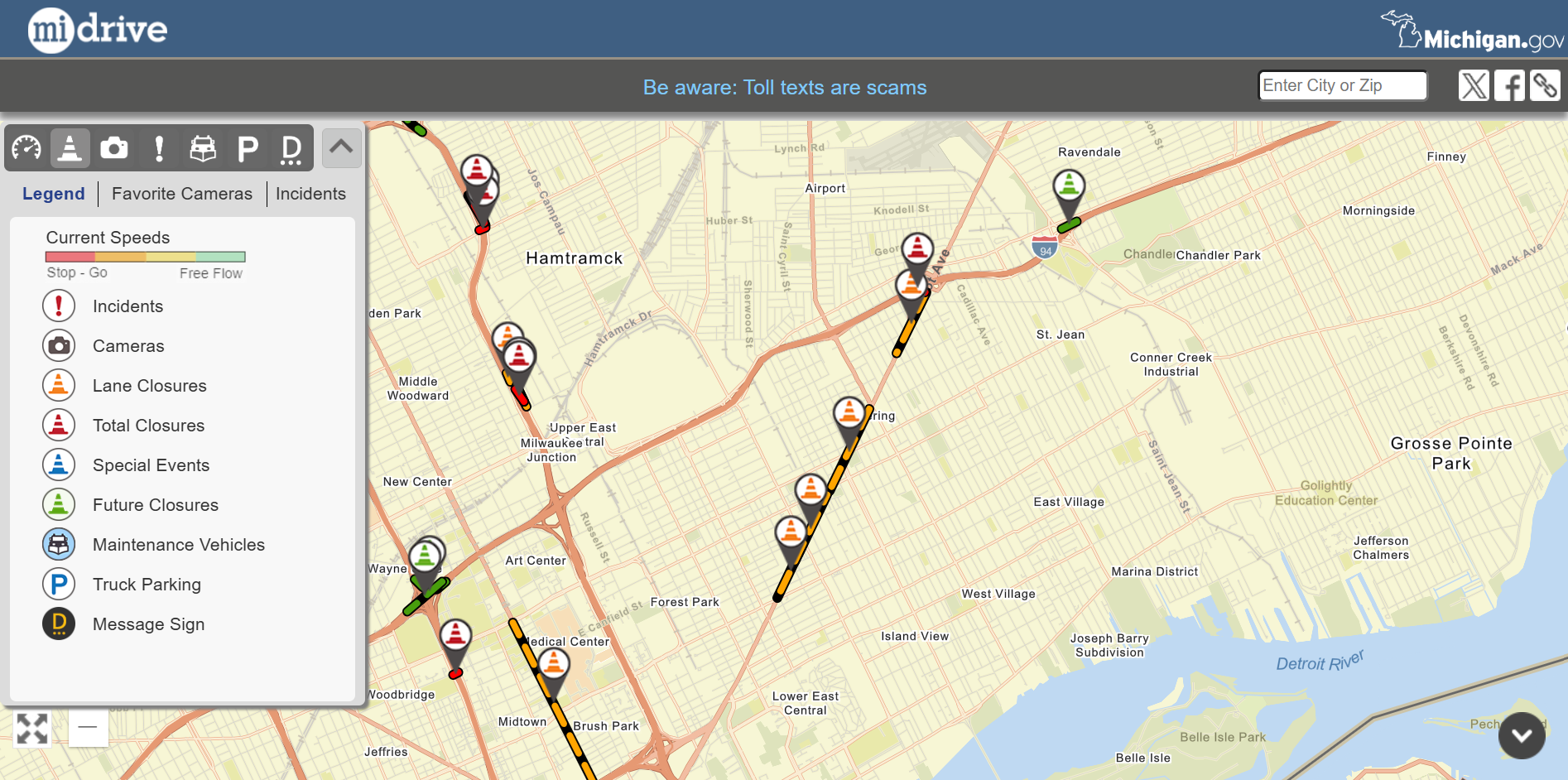
To view traffic cameras, speeds, locate incidents, and construction, be sure to check out the interactive website hosted by the Michigan Dept. of Transportation, MiDrive.
How to Use:
- Input the city or zip code in the search bar or use your mouse, stylus, or finger to navigate to the desired location on the map.
- Select the icons in the upper left to show the desired layers (construction, incidents, etc.) and the drop-down arrow to view the full legend and reference related map icons.
- Click on the icons to find more details.
Visit at mdotjboss.state.mi.us/MiDrive/map.
I-375 Reconnecting Communities Project Update
I have been monitoring and engaging in community and stakeholder discussions about the Michigan Dept. of Transportation’s plan to convert the I-375 freeway into a street-level boulevard for a decade. In 2016 and 2023, I held town halls to engage more community members about their concerns regarding this project. Over the years, MDOT and the City of Detroit have also held public meetings to gather community feedback and provide project updates; however, residents have continued to share concerns. In 2023, I wrote a letter to MDOT to amplify these concerns and advocate for further efforts to engage the community. There have been some design changes since then, such as the narrowing of lanes and wider sidewalks at the Lafayette junction.
This year, the city has been holding community meetings regarding the neighborhood framework and land use, with residents vocalizing what they’d like to see in the new parcels that will be available — residential, retail, entertainment, mixed use, and open (green) space all as options. I encourage everyone to review the city’s draft land use plan and zoning principles and stay up to date on the city’s neighborhood framework process by visiting: qrco.de/i-375detroit. You can also share feedback at i-375@detroitmi.gov.
This summer, my team and I have been meeting regularly with project leaders, the city, and representatives from the community to try to solve some of the problems and find a way forward. To stay up to date on this project, future meetings, and other road closures, visit michigan.gov/I375.
Water Infrastructure & Affordability
I have worked on the issue of water affordability my entire legislative career. Did you know the average household’s water costs have nearly doubled in the past 20 years? For the past two years I have convened a workgroup made up of water providers, advocates, local governments, community action agencies and United Ways, and a bipartisan group of legislators to address this growing issue. We’ve reintroduced Senate Bills 248-256 to create a statewide water affordability program, ensure shutoff protections, create a sustainable funding mechanism, and help tenants. More than 300,000 Michiganders would benefit from this program, including 1 in 4 Michigan senior citizens. Eligible households would also receive assistance with debts and simple plumbing repairs if it is determined that their water usage is elevated due to something like a leaky faucet or running toilet. Learn more at miwaterplan.com.
A major contributing factor to the rising cost of water is the need to update and repair our state’s aging water and sewer infrastructure. When households can’t afford their water bill, not only do water providers lose out on that flow of revenue to help them maintain and update their infrastructure, but they must spend time and money attempting to collect past due accounts or shut water off to that household.
My colleagues and I also know that as municipalities make road repairs, it is most cost-effective and efficient to replace local water and sewer infrastructure simultaneously. This is why we are working to invest in both local water and road projects.
Addressing Flooding
I’ve been working with local partners on the issue of flooding in some of our neighborhoods for a long time. When some of the state’s oldest infrastructure clashes with climate change, it can lead to disastrous results for the people and places we call home. Flooding has led to devastating property loss, mold in basements, and the destruction of healthy, livable spaces.
Since 2020, I have teamed up with other local lawmakers to secure funding to help us combat flooding in vulnerable communities, including the Jefferson-Chalmers neighborhood. With these resources, impacted communities have been able to make important seawall repairs, upgrade crumbling infrastructure, and offer support to residents impacted by flooding. I also previously introduced legislation to establish the Michigan Climate Resilience Corps to create job opportunities for young people to help make our neighborhoods more resilient to flooding and climate change. I‘ll keep advocating in Lansing for funding and policies that prevent flooding in our communities as well as partnering with Councilmember Latisha Johnson who has been leading the way at the city level.
For Detroiters, if your basement floods due to a backed-up sewer incident, contact DWSD to file a claim at (313) 267-8000. To prepare now, survive during, and stay safe after a flood.
Opening Soon: Gordie Howe International Bridge
After several decades of planning, community input, and construction, I’m excited that the Gordie Howe International Bridge is nearing completion, and with many community benefits addressing quality of life, environmental, and health impacts. While I no longer serve the district that includes Delray or Southwest Detroit, I’m proud of the work we did over many years alongside community members, the state, and the Windsor Detroit Bridge Authority to solve problems and secure tens of Millions of dollars in historic community benefits. The home repair program, air monitors, health impact assessments, and grants to community organizations have all made a tremendous impact.
Expected to open this fall, this once-in-a-generation project will be among North America’s top five longest bridges. It will provide six lanes of traffic and one multi-use path, offering a smoother, safer journey for bicyclists, pedestrians, and international travelers in the Detroit-Windsor region.
I was proud to be a part of the effort to ensure workforce development and training opportunities for Detroiters, and I look forward to seeing the impact for our local, regional, and international economy for years to come. Learn more and stay updated at GordieHoweInternationalBridge.com.